Deep Dive into the Planet's Most Strategic Bottleneck
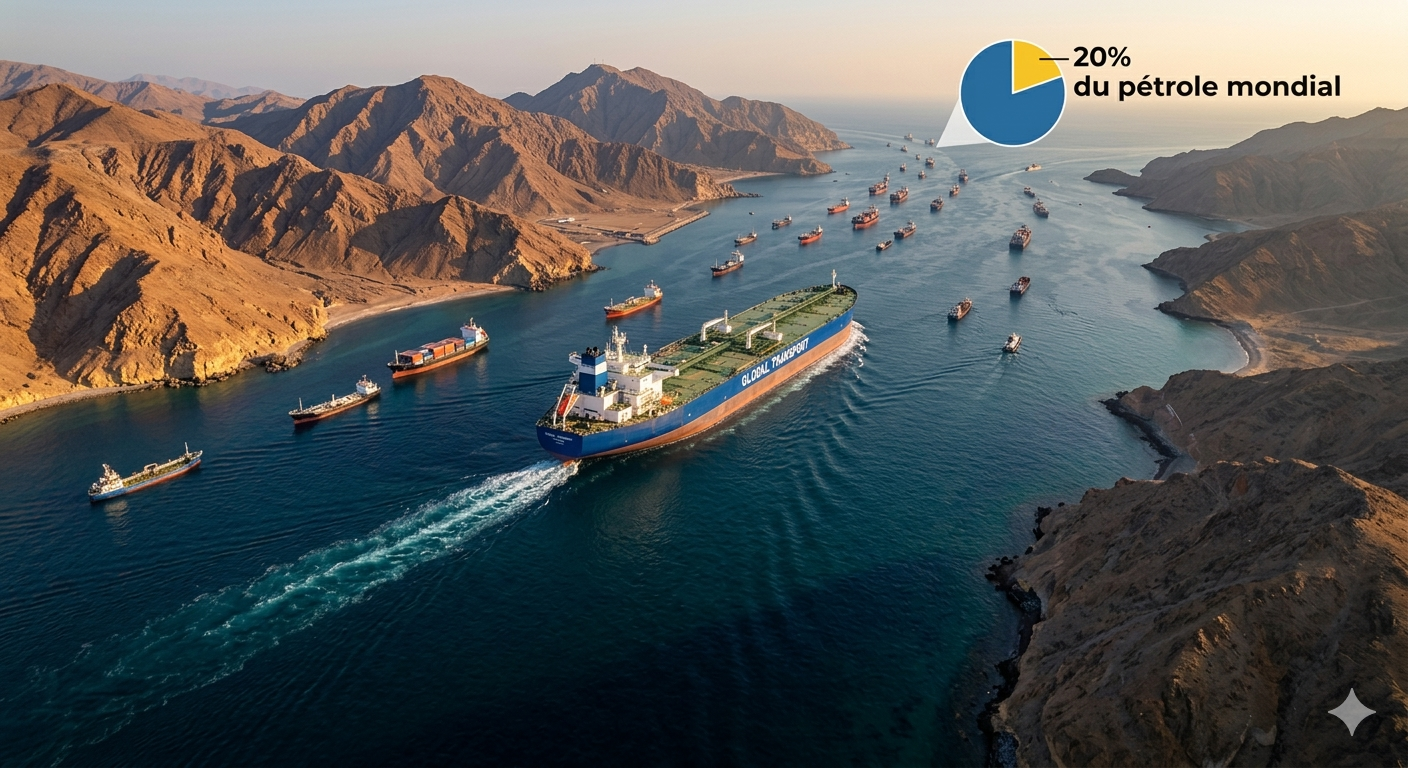
Imagine for a second that you are holding a faucet. An ordinary faucet, like the one in your kitchen. Now imagine that this single valve controls 20% of all the energy that keeps the global economy spinning. You immediately understand why everyone—from Wall Street traders to heads of state—watches this faucet 24 hours a day, 7 days a week.
That faucet is the Strait of Hormuz.
Located between Iran and Oman, this maritime corridor is only 33 kilometers wide at its narrowest point. It is far more than a line on a map: it is the beating heart of global geopolitics. Yet the math seems counterintuitive: how can 20% of the world's oil bring the remaining 80% to its knees? Let's break down this fascinating and terrifying equation.
1. The Raw Data: Setting the Stage
To understand the scale, let's look at what flows through Hormuz each day:
- Daily Volume: Approximately 20.5 million barrels of crude and refined products.
- The Comparison: This is equivalent to the total daily consumption of the United States, or the combined consumption of Japan, Germany, and France.
- Global Share: It represents 20% of global production, but more importantly, 30% of all oil traded by sea.
- The Players: The giants of the Gulf—Saudi Arabia, Iraq, the United Arab Emirates, Kuwait, and Iran—all depend on this "liquid highway" to reach their customers.
2. The 20% Paradox: Why the Other 80% Can't Save Us
Your intuition might tell you: "If 20% disappears, we still have 80% left, right?" Here is why this logic fails when physics meets market psychology.
A. The Physical "Choke Point" Effect
Imagine a ten-lane highway that suddenly narrows into a two-lane tunnel for a few miles. That is Hormuz.
- Zero Immediate Alternatives:You cannot simply "flip a switch" to replace 20 million barrels. Bypass pipelines (like the East-West pipeline in Saudi Arabia) have strictly limited capacities. Tankers cannot fly over mountains.
- Refinery Rigidity: Gulf oil is often "light sweet crude"—the gold standard because it is easier to refine. Refineries in Asia and Europe are calibrated specifically for this grade. Switching to a different type of oil is like trying to put diesel in a gasoline engine: technically possible after massive, costly modifications, but it takes months.
B. The "Market Panic" Multiplier
This is the most volatile factor. Oil markets do not react to what is happening; they react to what traders fear will happen next.
- Instant Spikes: A blockade would not raise prices by 20%. It would cause the price per barrel to jump by 100% to 300% within days.
- Price Alignment: Oil is a global commodity. If Brent Crude hits $200 because of Hormuz, American or Canadian oil will follow suit instantly. No producer will sell their oil for less than the global market rate.
3. The Domino Effect: When 20% Paralyzes Everything
Closing Hormuz is not just about "losing volume." It triggers an unstoppable chain reaction.
- Asia Grinds to a Halt: China, India, Japan, and South Korea get the vast majority of their energy from the Gulf. Within weeks, their ports would be paralyzed. No oil means no transportation, no factories, and no electricity.
- Europe Pays the "War Price":Already sensitive to energy costs, Europe would see its electricity bills explode. Heavy industries (chemicals, steel, glass) would become unprofitable overnight.
- Universal Inflation: 80% of global trade moves by sea. Ships run on heavy fuel oil. If fuel triples in price, everything triples: Ecuadorian bananas, Taiwanese microchips, and German cars.
- Global Recession: Households, suffocated by the cost of living, stop spending. Companies lay off workers. The IMF calls this a "major oil shock"—a systemic collapse of growth.
4. The "Suicidal Deterrent": Why Hasn't the Strait Been Closed?
If it is such a powerful weapon, why hasn't Iran closed it? Because it would be economic suicide.
- Military Response: The U.S. Fifth Fleet is stationed in Bahrain for one reason: to keep this passage open. A blockade is a "red line" that would trigger immediate international military intervention.
Self-Inflicted Damage: Iran needs the strait to export its own resources. Closing it would starve its own economy.
The Diplomatic Nuclear Card: The strait is a deterrent. It is a card Iran holds for negotiations. Once you play the card, you lose your leverage.
5. The Actors Involved: Who Is Playing This Dangerous Game?
- The United States: Plays the role of maritime enforcer to guarantee freedom of navigation.
- Iran: Acts as the gatekeeper, using the threat of closure as a diplomatic lever, particularly regarding its nuclear program.
- Saudi Arabia: The world's largest exporter, facing extreme vulnerability and investing in alternative pipelines.
- China: The world's largest importer with near-total dependence on Gulf oil and a strong interest in regional stability.
- India, Japan, and South Korea: Asian customers with maximum vulnerability, exerting constant diplomatic pressure to keep the strait open.
6. Possible Scenarios: What Could Happen Tomorrow?
- Scenario A (Controlled Escalation): Iran harasses ships or seizes a tanker. Prices rise by 20-30%. Maritime insurance costs explode.
- Scenario B (Partial Blockade): Iran closes the strait for a few days as a show of force. Prices jump 50-100% before retreating based on the response.
- Scenario C (Open War): Major conflict. The strait is mined. Traffic is interrupted for weeks. Oil prices exceed $200-300. Global recession guaranteed.
7. The Alternatives: Can We Bypass Hormuz?
- East-West Pipeline (Saudi Arabia): Capacity of 5 million barrels/day. Operational but limited.
- Habshan-Fujairah Pipeline (UAE): Capacity of 1.5 million barrels/day. Operational.
- Iraq-Turkey Pipeline: Capacity of 1 million barrels/day. Operational but fragile.
- Cape of Good Hope Route: Unlimited capacity but adds 15 days of travel time and massive additional costs.
Conclusion: No alternative can replace Hormuz in the short term. The strait remains an unavoidable bottleneck.
8. What This Means for You
You are not an oil trader or a diplomat, yet Hormuz affects you directly:
- At the Pump:Tension translates into an immediate increase in fuel prices.
- On Your Plate:Food transportation depends on fuel. Food prices follow.
- In Your Wallet: Inflation reduces your purchasing power.
- In Your Job: A global recession can put your employment at risk.
Thirty-three kilometers of saltwater control part of your daily life, even thousands of kilometers away.
Conclusion: The 33 Kilometers Worth Their Weight in Gold 💰
The Strait of Hormuz is the ultimate proof that in geopolitics, location beats volume. These 33 kilometers control 100% of global price stability. It is the "Achilles' heel" of our industrial civilization. The next time you hear about tensions in the Gulf, remember: it is not the quantity that creates power—it is the dependency. And this dependency, we all carry it, every day, in our engines, our plates, and our wallets.
Questions for Reflection
If a single strait can bring the world to its knees, has our civilization built its prosperity on foundations that are dangerously fragile? What would happen if, tomorrow, it were not a political blockade but an accident or sabotage that closed Hormuz? Are we prepared to accept such concentrated vulnerability?
And you—do you believe the world should accelerate its energy transition to escape this dependency, or will alternatives (renewables, nuclear, hydrogen) take too long to free us from this bottleneck?